
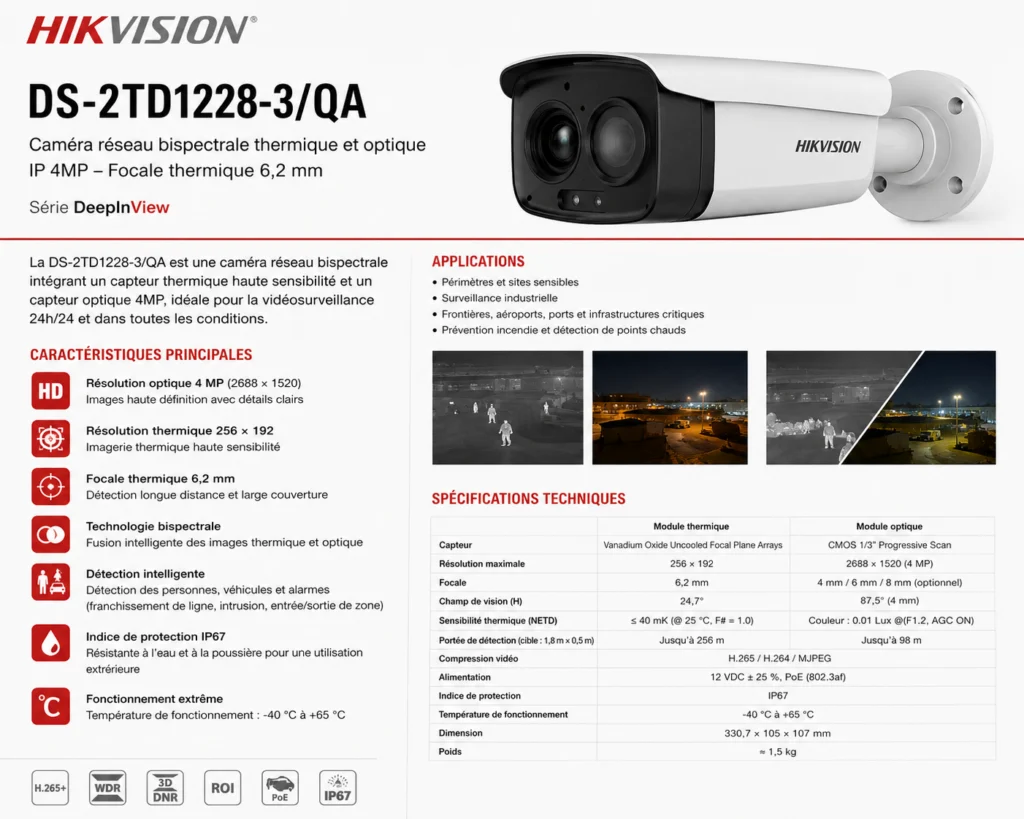
Description
An ordinary camera needs light. In total darkness, in airborne dust, behind smoke or against strong backlight, it no longer returns anything usable.
A bi-spectral camera carries two sensors. The thermal sensor does not see light but heat: a human presence stands out from its background, day or night, with no lighting at all. The optical sensor gives the image that allows you to recognise — a face, a plate, clothing.
What each sensor can and cannot do
Thermal detects but does not recognise: on a thermal image, two people look alike. Optical recognises but stops detecting as soon as light is missing. Their pairing is what makes them useful, which is why they share one housing.
What to know before ordering
The thermal focal length sets the detection range: the longer it is, the further you detect, but the narrower the field. The choice therefore comes from a distance and a zone width, not from a catalogue. Tell us what you are watching — a fence, a yard, a dock — and we point you to the right focal length.
We supply the equipment. Poles, network connection and detection-zone tuning are separate services.

Reviews
There are no reviews yet.